

Luxury Stationery for Small Businesses: 2026 Guide
Last Updated: 23 October 2026
Quick Summary
Luxury stationery for small businesses is professionally printed, design-led paper goods made with heavier stock, sharper print and considered typography rather than thin, generic bulk sheets. It works best as a business tool, lifting a few high-visibility touchpoints such as letterheads, business cards and branded thank-you cards.
- Standard office paper sits around 80gsm, so ask suppliers for the exact gsm figure before ordering.
- Digital printing suits short runs and quick turnaround, making it the sensible starting point for most small businesses.
- Our Clustered bonnet fungi greeting card is printed on 250g FSC certified card, A6, with a matching white envelope.
- UK orders pay one postage charge across multiple cards, keeping the per-card cost sensible.
- Approve a physical proof before any large run, as colours shift between screen and press.
Table of Contents
- What Luxury Stationery Means for a Small Business
- Why Premium Stationery Pays Off for Small Business Stationery
- Choosing Paper and Print Quality for Business Letterhead Printing
- Branded Thank-You Cards That Customers Actually Keep
- Business Stationery Design: Getting the Details Right
- Where to Buy Luxury Stationery for Small Businesses
- Common Mistakes When Buying Premium Stationery
- Conclusion
- Frequently Asked Questions
What Luxury Stationery Means for a Small Business
Luxury stationery for small businesses is professionally printed, design-led paper goods, from letterheads and business cards to branded thank-you cards, made with heavier stock, sharper print and considered typography rather than the thin, generic sheets sold in bulk. At Marcus Brown, we treat it as a business tool: a physical signal of care that a mass-market pad cannot send.
The definition matters because "luxury" is often misread as decoration. It is really a set of measurable choices: paper weight, print method, finish and consistency across every item you send out.
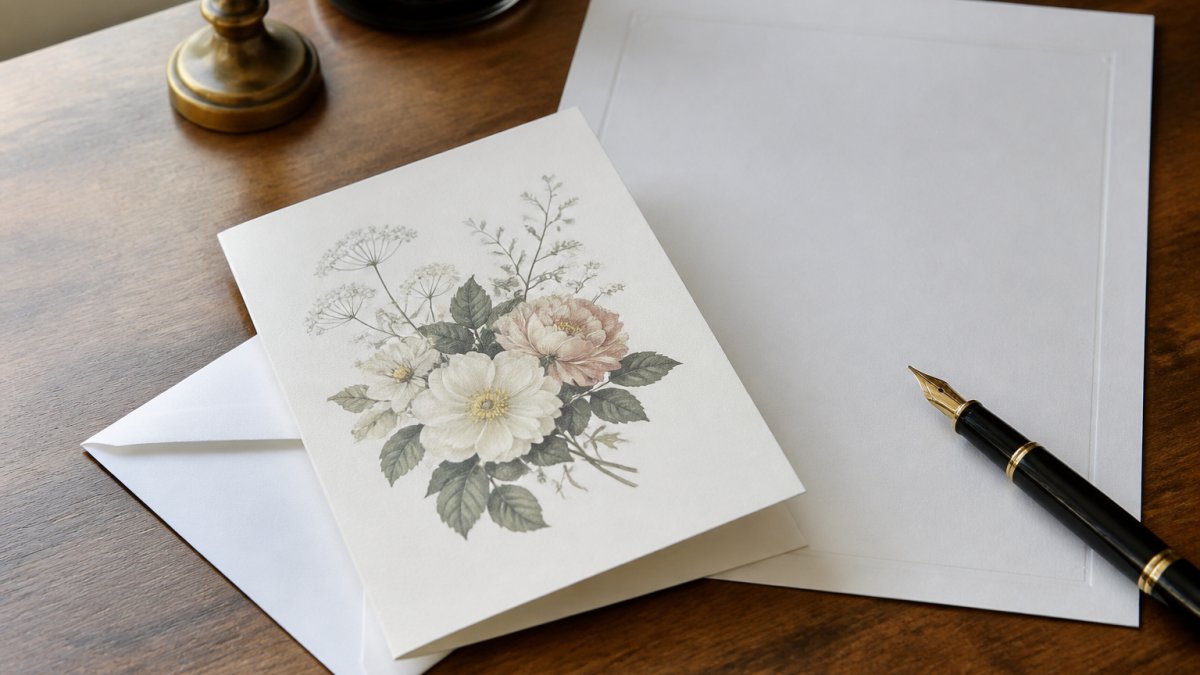
A common mistake is assuming this category is only for firms with huge print budgets. It is not. A small business can lift the perceived value of its correspondence by upgrading a handful of touchpoints: the invoice cover, the thank-you card, the letterhead used for a handful of key clients each month.
Why Premium Stationery Pays Off for Small Business Stationery
Premium small business stationery earns its keep because physical mail is now rare enough to command attention. When most correspondence is email, a properly printed card or letterhead lands differently, and recipients tend to hold onto it rather than bin it.
Here is what that means in practice. A branded thank-you card that survives on a client's desk keeps your name in the room long after the transaction. A letterhead that feels substantial signals that the business behind it is established and careful. Neither claim requires a big team or a large marketing spend.
There is a commercial argument too. Businesses that invest in quality presentation generally find it reinforces their pricing: if your invoice arrives on flimsy paper with washed-out print, discount expectations creep in before a client has read a word.
Choosing Paper and Print Quality for Business Letterhead Printing
Business letterhead printing quality comes down to two variables: the paper stock and the print method. Get those right and the rest of the design has something solid to sit on.
Paper weight is the first checkpoint. Standard office paper sits around 80gsm and feels insubstantial in the hand. Premium letterhead typically uses heavier uncoated stock, which takes ink cleanly and feels deliberate to the touch. Ask any supplier for the exact gsm figure before ordering; a vague "premium quality" claim tells you nothing.
Print method matters as much. Digital printing suits short runs and quick turnaround, while lithographic printing tends to hold fine detail and flat colour across longer runs. For most small businesses, digital is the sensible starting point.
Finish is the third decision. A matt finish reads as understated and refined; gloss draws the eye but can look cheap under certain lighting. Uncoated stock with a matt finish is the safer choice for professional correspondence.
When you brief a printer, ask these questions before committing:
- What is the exact paper weight in gsm?
- Is the stock FSC certified or otherwise responsibly sourced?
- What is the minimum order quantity, and does the price per unit drop at higher volumes?
- Can I see a physical proof before the full run?
- What is the turnaround time from proof approval to delivery?
That last point matters more than people expect. Royal Mail's guidance on business mail is a useful reference for planning postage alongside print deadlines, particularly if you send seasonal mailings.
Branded Thank-You Cards That Customers Actually Keep
Branded thank-you cards work when they feel like a genuine gesture rather than a marketing insert. The difference is usually in the physical details: heavier card, a clean design, and a handwritten line.
Our Clustered bonnet fungi greeting card is printed on 250g FSC certified card, A6 in size, and comes with a matching white envelope. It is hand-printed by me.

Three design rules make a thank-you card worth keeping:
Clustered bonnet Fungi Greeting Card, Botanical Print, Nature-Inspired Gift →
- Keep the branding quiet. A small logo and a clear sender name beat a full sales pitch.
- Leave room to write. A blank interior with space for two or three handwritten lines outperforms a pre-printed message every time.
- Match the occasion. A Common puffball greeting card suits a nature-loving client; a Lake Landscape Card reads as calm and considered. Matching the card to the person is what turns a formality into a keepsake.
Business Stationery Design: Getting the Details Right
Business stationery design succeeds when every element is consistent across every format. The most common failure is a beautiful business card that shares nothing visually with the invoice that follows it.


Start with a small set of fixed rules and apply them without exception:
| Element | What to fix | Why it matters |
|---|---|---|
| Typeface | One heading font, one body font | Mixed fonts read as amateur |
| Colour | Two brand colours plus neutral | Consistent colour builds recognition |
| Logo placement | Same position and size on every item | Repetition signals control |
| Margins | Defined clear space around all edges | Prevents cramped, cheap-looking print |
| Paper stock | One weight for cards, one for letters | Tactile consistency across touchpoints |
Beyond the grid, think about how each item is used. A letterhead needs generous margins for a printed letter; a compliment slip needs space to write; a card needs a blank interior. Design for the actual use, not for a portfolio shot.
If you are working with a designer, brief them on the full set at once, not item by item. It costs less to establish the system once than to retrofit consistency later.
Where to Buy Luxury Stationery for Small Businesses
Where you buy determines the ceiling on quality. Mass-market retailers can supply basic cards and paper, but the stock is usually light and the designs generic. For business correspondence, that gap shows.
Three routes are worth considering:
- Specialist design-led printers. These businesses focus on print quality and distinctive design, and they usually offer a curated range rather than a catalogue of thousands. This is where we sit: our cards are professionally printed on 250g FSC certified stock, hand-finished in small batches, and shipped globally with fast delivery.
- Local print shops. Good for bespoke letterheads and short runs, and useful if you want to handle proofs in person. Quality varies, so always request a physical sample.
- Online custom printing services. Convenient for volume, but the paper often disappoints. Check the gsm figure and order a sample before committing to a large run.
Whichever route you take, the test is the same: hold a sample in your hand before you buy in quantity. WRAP's guidance on responsible paper sourcing is a helpful reference if environmental certification matters to your brand, as it does to ours.
Common Mistakes When Buying Premium Stationery
The most expensive mistake in premium stationery is buying for appearance rather than for use. A thick, heavily textured card that will not feed through a printer, or a letterhead in a finish that smudges, becomes a problem rather than an asset.
Others we see regularly:
- Skipping the physical proof. Screen colours and print colours differ. Always approve a physical sample.
- Ordering too few. Reprinting a small batch later often costs more per unit than ordering slightly ahead.
- Over-branding. A card covered in logos leaves no room for a personal message and reads as advertising.
- Ignoring postage. Unusual sizes and heavy stock can push you into a higher postage band. Check the dimensions against standard letter rates before you commit.
- Buying everything at once. Upgrade your highest-visibility items first and expand once you know what works.
Conclusion
The challenge for most small businesses is not finding stationery; it is finding stationery that reflects the standard of the work behind it. Mass-market options undercut your pricing before a client has read a word, while a considered set of printed pieces quietly does the opposite.
That is the problem we built Marcus Brown around. We specialise in professionally printed greeting cards, calendars and planners with superb print quality, hand-printed by me and shipped globally with fast delivery. Start with one touchpoint, a thank-you card or a set of letterheads, and see what a difference proper stock and print make.
Frequently Asked Questions
What is the difference between standard and luxury stationery?
The difference comes down to paper weight, print quality and finish. Standard office stationery is usually lightweight copier paper, while luxury stationery uses heavier stock, such as 250gsm FSC certified card, with a quality matt finish. Print quality is sharper, colours are more accurate, and the item often arrives with a matching envelope and protective packaging. For a small business, that extra weight and finish is what makes a letterhead or thank-you card feel considered rather than mass-produced.
What stationery does a small business actually need?
Start with the items customers and suppliers physically handle: letterhead for formal correspondence, branded thank-you cards for orders and referrals, business cards, and envelopes that match. Add notebooks or planners if you deal with clients face to face. You do not need everything at once. Many small businesses begin with letterhead and thank-you cards, then expand once they see how recipients respond. Order a small batch first and check the paper weight and print sharpness before committing to larger runs.
Is personalised stationery worth it for a small business?
It depends on how often you post or hand over physical items. If you send invoices, proposals, thank-you notes or gifts, personalised stationery carries your branding into every one of those moments. The cost per item is higher than generic alternatives, but a single well-printed card can sit on a client's desk for months. If you rarely send anything by post, put your budget into business cards and digital branding instead.
Which paper is best for premium business stationery?
Look for FSC certified stock at 250gsm or above for cards and letterhead. The certification confirms the paper comes from responsibly managed sources, and the weight gives a firm, premium feel in the hand. A matt finish suits photographic and botanical designs because it keeps colours rich without glare. Lighter paper, around 120gsm, works for everyday letterhead but will feel thin next to a 250gsm card, so keep your key customer-facing pieces consistent.
If your correspondence currently undersells the business behind it, that is worth fixing. Marcus Brown offers design-led printed stationery with genuinely premium print quality, FSC certified stocks and reliable global shipping, so you can send something clients keep rather than bin. Get started with Marcus Brown and put your brand on paper that matches the work you do.
